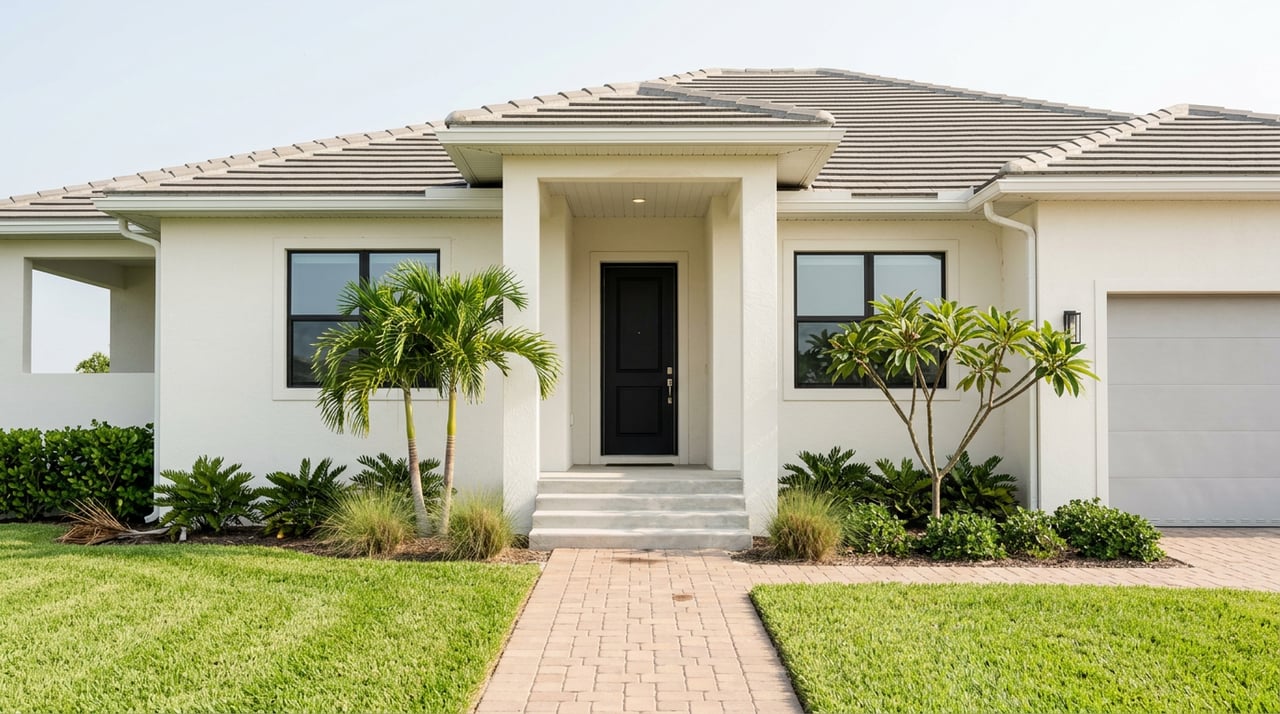
Drive north on Burnt Store Road past Pine Island Road this month and you will pass three kinds of houses in the space of a mile: a canal-front resale with a mature landscape and a "for sale" sign that has been up for a while, a cluster of nearly identical spec homes with sod still holding its store-bought green, and, set back from the road, the graded dirt where Cape Coral Grove is about to become the biggest single development the city has ever approved. That stretch of road is not a coincidence. It is the clearest place in Cape Coral to watch a mechanism that is quietly setting resale prices across the city, and it has nothing to do with the median price everyone quotes.
The builder is the competition now, not the neighbor
Homeowners selling in Cape Coral tend to compare their house to the one down the street. That comparison is increasingly the wrong one. New construction has held above 30 percent of the city's active inventory for most of 2026, and as of Q1 2026, homes built in 2020 or later made up close to 39 percent of active listings and accounted for roughly 40 percent of all closed sales in 2025. A resale seller is not competing with the neighbor's kitchen remodel. They are competing with a production builder who has a construction loan accruing interest every day a finished home sits empty.
That distinction matters because a builder and a homeowner respond to price pressure differently. An individual seller can wait. A builder generally cannot, since property taxes, insurance, and loan interest keep accumulating on unsold inventory whether or not a buyer shows up. That single difference in incentive explains most of what is happening to resale pricing right now. As of Q1 2026, the median price of active new-construction listings in Cape Coral sat near $464,000, while completed new homes were actually closing around $379,000, a gap that shows builders discounting finished, ready-to-close inventory well below what they are asking for homes still on paper. Resale sellers who price against last year's comps, rather than against what a builder down the street is currently willing to accept, are the ones sitting longest.
Builders are also stacking incentives in ways an individual seller cannot easily match. In the Burnt Store Road corridor of northeast Cape Coral, rate buydowns, closing cost credits, and lot price reductions were running as separate line items in spring 2026, and buyer's agents reported combined packages reaching $40,000 to $60,000 in total value on mid-range new homes when a buyer negotiated all three at once. A resale seller offering to cover a home warranty or a few points of closing costs is not competing with that math. They are competing with a builder who can move on rate, price, and upgrades simultaneously and still protect margin on the next spec home.
Where the pressure actually concentrates
This is not evenly distributed across the city, which is the part most coverage of Cape Coral's "correction" leaves out. The pressure is heaviest in the quadrants where scattered lots and platted infrastructure make it easiest for builders to work at scale, and lightest where the product simply cannot be replicated.
Northwest Cape Coral, where the density of new construction is highest, carries a localized oversupply risk: multiple builders competing for the same buyer pool with nearly identical floor plans compresses pricing for new homes and drags down the value of adjacent resale inventory in the same stretch. Northeast Cape Coral tells a similar story from a different angle. As of early 2026, that quadrant was the fastest-growing residential section of the city, with more than 120 new building permits issued annually along the Burnt Store Road corridor, which means the builder-versus-resale dynamic there is still accelerating rather than leveling off.
Waterfront and Gulf-access resale sit outside this pressure almost entirely. Waterfront land in Cape Coral cannot be manufactured, and a home with direct Gulf access, meaning no fixed bridges between the dock and open water, continues to command a real premium over freshwater canal homes regardless of what a builder is offering three streets inland. The correction most people are describing when they call Cape Coral a buyer's market is really a correction concentrated in dry-lot, non-waterfront inventory, especially in the quadrants where builders are most active.
| Segment | Share of the pressure | What's setting the price |
|---|---|---|
| New construction, citywide | 30%+ of active listings | Builder carrying costs force incentives; active median near $464,000 vs. sold median near $379,000 in Q1 2026 |
| Non-waterfront resale | Bulk of the market | Competes directly with builder incentive packages; where most price corrections are concentrated |
| Gulf-access waterfront | Limited, scarce | Scarcity, not builder competition; holds a premium over freshwater canal homes |
A resale house does not lose value because the market softened. It loses value because a builder three doors down can offer a rate buydown and a warranty the resale seller has no way to match.
Citywide, the sale-to-list ratio has held near 96 percent through most of 2026, and months of supply peaked near 8 to 9 months early in the year before easing into a 5.5 to 7 month range by August, depending on the neighborhood. Those are the numbers that get quoted as "Cape Coral's market." They describe an average of two very different markets sitting inside the same city limits.
Two costs the median price doesn't show
Two line items widen the gap between new and resale further, and neither shows up in a portal's median-price number.
The first is insurance. Homes built to current wind-mitigation code, generally 2022 or later, are quoting meaningfully lower premiums than older homes in the same neighborhood. Impact-rated windows alone have been reported to lower premiums by an average of 22 percent compared to homes without them. A 15-year-old resale with an aging roof is not just competing on sale price against a comparable new build. It is competing on a monthly cost the buyer's insurance agent will quote within days of an accepted offer.
The second is the Utilities Extension Project, or UEP, and it lands hardest in exactly the quadrants where the builder pressure is already concentrated. In November 2025, Cape Coral's City Council approved the assessment structure for the North 1 East UEP phase, which covers roughly 7,300 parcels generally east of Del Prado Boulevard and west of US 41, according to Cape Coral Breeze's reporting on the council vote. The estimated total assessment for a standard residential lot came to $32,288, payable as a lump sum or financed on the property tax bill over 20, 25, or 30 years at up to 6.25 percent interest, with the default 30-year term running about $3,385 a year. First billing is set for November 2026. By May 2026, the city had authorized $210 million in bonds to fund that phase and the backbone infrastructure behind it, a sign of how much capital the northeast corridor's build-out is now carrying.
For a resale buyer, an unpaid UEP assessment is not a footnote. It is a five-figure number that needs to be confirmed before closing, and whether it has been paid off, is being financed, or is still pending can change the real cost of a resale home more than the difference in list price against a comparable new build a mile away.
Why the timing matters right now
None of this is theoretical for the corridor where the pressure is heaviest. Cape Coral Grove, a mixed-use town center backed by a $700 million private investment on a 131-acre site along Pine Island Road between Chiquita Boulevard and Burnt Store Road, adjacent to Bubba's Roadhouse & Saloon, is planned to bring more than 350,000 square feet of retail, dining, and entertainment space, according to the City of Cape Coral's own project page. Developed by L&L Development, a firm with a track record in New York City and Miami, the project moved from graded dirt to active ground infrastructure in the first quarter of 2026, with vertical construction on the first commercial buildings and roughly 1,234 apartment residences targeted for the third quarter of this year, the same window we are in right now. That puts it in the same northwest corridor already carrying the city's densest concentration of new-construction resale competition.
That means the quadrant absorbing the most builder pressure on home prices is about to gain the amenity draw that could eventually support those prices. For a buyer weighing a resale home against a builder's incentive package in that same stretch, or a seller trying to price against both, the answer six months from now may look different from the answer today. That is not a reason to wait. It is a reason to price against the specific quadrant, phase, and UEP status of an actual address rather than against a citywide median that blends waterfront scarcity with inland oversupply into one misleading number.
What this means for your next move
If you are selling a non-waterfront resale home anywhere near the builder-dense parts of northwest or northeast Cape Coral, price against the total incentive package a comparable new build is offering, not just its list price. If you are buying resale in one of those same corridors, ask specifically which UEP phase the address falls under and whether the assessment has already been satisfied. If you are buying or selling on Gulf-access water, most of this mechanism does not apply to you at all, since scarcity is doing the work that builder incentives are doing everywhere else.
Every one of these questions comes down to a specific address, a specific quadrant, and a specific phase of infrastructure that changes street by street. That is the kind of comparison Top Selling Realty runs for buyers and sellers across Cape Coral every week. If you are trying to figure out where your address actually sits in this picture, reach out and we will walk through it with you.