A buyer we know spent three weekends looking at "Gulf access" homes in Cape Coral last spring, wrote an offer on a canal house south of Veterans Parkway, and killed the deal at inspection when a marine surveyor pointed at the fixed bridge two lots down and told him his 28-foot center console with the T-top would clear it on a calm morning but not at a summer king tide. He had already wired earnest money. The listing said "Gulf access." The listing was not lying.
That is the whole problem with the label. "Gulf access" in a Cape Coral MLS description is three completely different products sold at three completely different prices, and the gap between them is where most out-of-area buyers overpay or walk away from the wrong deal.
The label hides three products
Cape Coral has roughly 400 miles of navigable canals, more than any other city in the world. What matters for the price tag is not the mileage. It is which of these three tiers a specific canal falls into.
| Canal tier | What it means for boating | 2026 price band, standard 3/2 |
|---|---|---|
| Freshwater canal | Landlocked. Kayaks, jet skis, bass fishing. No boat to the river. | ~$390K–$450K |
| Indirect Gulf access | Reaches the Caloosahatchee, but one or more fixed bridges sit in the route. Boat height matters. | ~$450K–$750K |
| Direct sailboat access | No bridges, no locks between the dock and the river. Any hull, any air draft. | ~$700K–$2M+ |
Sources across the local market converge on those bands for early 2026, with the citywide median Gulf-access single-family home tracking around $730,500 year-to-date. The dry-lot baseline for the same 3/2 sits closer to $330K–$380K. That means a buyer paying a "waterfront premium" is really paying one of three separate premiums, and the listing description almost never tells you which.
The direct-access tier concentrates in two pockets. The older inventory sits in Southeast Cape, feeding the Yacht Club basin and Bimini Basin through canal reaches that were dug in the 1960s and 1970s. The newer inventory sits in Southwest Cape around Cape Harbour, Tarpon Point, and the 8 Lakes area, with 2026 coastal-contemporary builds delivering on lots that carry no bridge restrictions. Streets like Surfside Boulevard and Rose Garden Road show up repeatedly on sailboat-compatible searches. Freshwater inventory dominates the Northeast and Northwest quadrants, which is also where builders like DR Horton, Maronda, and LGI are the most active.
Why any comp older than June 2025 needs to be re-checked
This is the piece that has not filtered into most listing narratives yet. The Chiquita Lock, installed in the 1980s at the mouth of the South Spreader Canal to filter runoff before it hit Matlacha Pass, closed to boaters on April 1, 2025 and was removed ahead of schedule. The City of Cape Coral confirmed removal was complete on June 17, 2025, with a bathymetric survey of the South Spreader, 3,000 mangrove plantings, and oyster reef balls scheduled as follow-on work.
For a boater in SW Cape, the lock was a wait. For a comp analysis, the lock was a discount. Canal reaches that historically required a lock cycle to reach open water were priced accordingly. Post-removal, those same reaches now behave like unrestricted direct access, and a pull of sale comps from 2023 or 2024 will systematically undervalue what a similar home sells for in 2026.
If a listing agent hands you comps from before June 2025 for a home south of the old lock, ask for a second pull dated after July 2025. The mechanism that produced those earlier prices no longer exists.
The Sanibel-Captiva Conservation Foundation has raised unresolved water-quality questions about the removal, which is worth knowing if you plan to swim from your dock. It does not change the pricing story.
The seawall belongs to you, not the city
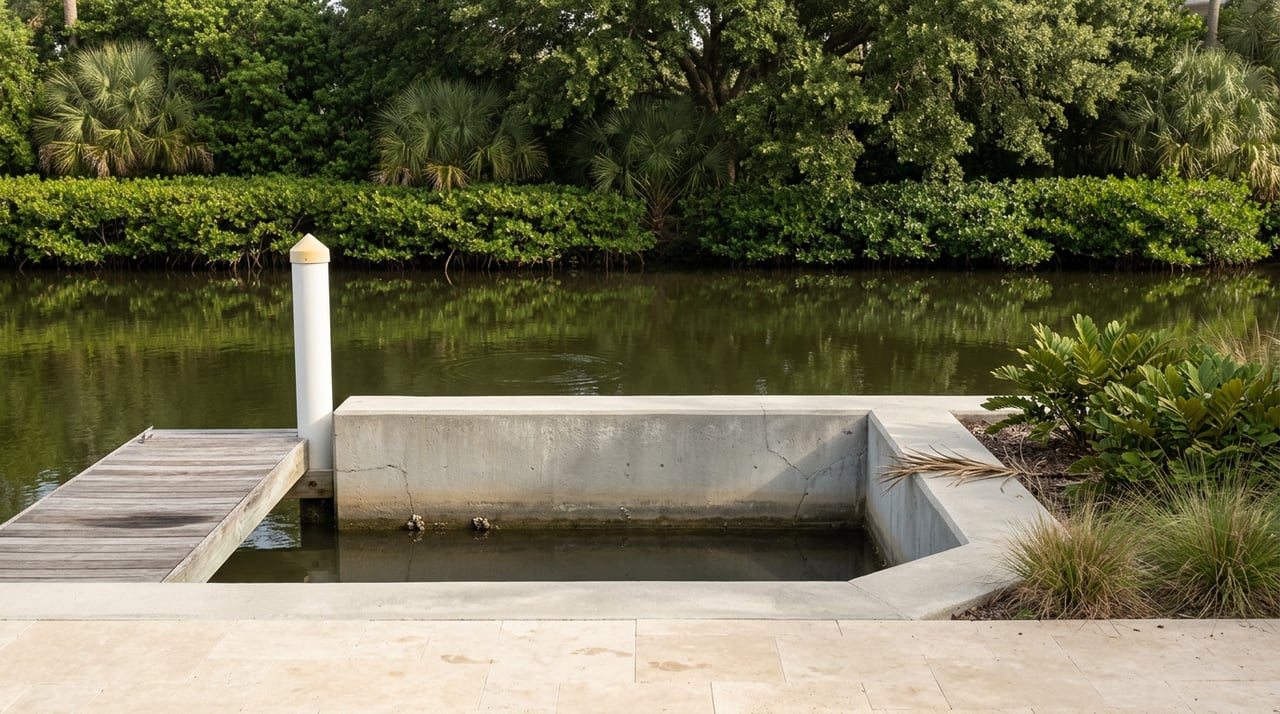
Almost every buyer relocating from a lake state or a coastal HOA assumes the shoreline structure is a shared asset. In Cape Coral it is not. The seawall is on your parcel, it is your maintenance, and it is your bill when it fails.
The bill is not small. In 2026, vinyl sheet pile seawalls in Cape Coral run about $400 to $650 per linear foot installed, and concrete panel systems run about $650 to $900 per linear foot. A standard Cape Coral lot has roughly 80 feet of waterline. Do the arithmetic and a full replacement lands somewhere between $32,000 on the low end and $72,000 on the high end before change orders.
Change orders are the second problem. A large share of the original 1960s and 1970s concrete caps show measurable rebar corrosion, and once a cap pulls away from the panel below, dredge fill behind the wall drains into the canal in cubic yards over a single tide cycle. That failure mode is one of the most common triggers for a repair bid to convert into a full replacement mid-project. Hurricane Ian, which made landfall September 28, 2022, damaged thousands of Cape Coral canal seawalls, and marine contractors are still pulling Ian-related permits three-plus years later.
City permits for a residential seawall repair are administratively cheap. The permit fee is $180, with a turbidity screen required around the work zone. Everything else on that job is contractor-driven.
What this means when you tour a canal home: ask the age of the wall, ask whether the cap has been replaced, and put a marine survey contingency in the contract the same way you would put a WDO or a four-point.
The bridge clearance on paper is not the bridge clearance on the day
Fixed-bridge clearances across Cape Coral's canal system range roughly from 9 feet to 15 feet. Those numbers are quoted at mean high water. King tides in the summer can shave another two feet off the effective clearance, and a T-top, radar arch, or antenna array is part of your boat's air draft whether you remember it or not.
The transaction pattern that produces broken deals looks like this: a buyer measures the boat sitting on the trailer, subtracts nothing for antennas, checks the listed clearance on the nearest fixed bridge, and writes the offer. The marine surveyor comes out during inspection, adds three inches for the anchor light and eleven inches for the T-top, factors in high tide, and delivers the bad news.
The verification path is simple and the buyer can do it themselves before writing:
- Measure the boat's actual air draft from waterline to highest fixed point, including antennas.
- Pull the fixed-bridge clearance from U.S. Coast Guard bridge data, not the listing.
- Subtract 18 to 24 inches for tide and safety margin.
- If the answer is negative on any bridge in the route, the property is not the boating home you think it is.
Flood zone is the second price tag
A canal address in Cape Coral usually means FEMA Zone AE, which means a mortgage-required flood policy. Streets with Gulf exposure can fall into Zone VE at higher premiums still. Non-waterfront blocks a few streets in often sit in Zone X, where flood insurance is optional. The delta between AE and X on a comparable home can run north of $2,000 a year, compounding over the life of the loan into a real six-figure carrying-cost difference. Verify the parcel-specific zone at msc.fema.gov before the offer, not after.
Reading a Cape Coral listing description like a local
The phrases the market uses are unregulated. Translation matters.
- "Gulf access" with no other qualifier: assume indirect with at least one fixed bridge until proven otherwise.
- "Direct access" or "no bridges": closer to the real thing, still verify against a map of the canal route to the river.
- "Sailboat access": the strongest claim. Should mean unobstructed vertical clearance the whole way. Confirm anyway.
- "Intersecting canal" or "wide canal view": this is a resale premium in its own right. A 200-foot canal shows and sells differently than an 80-foot canal even at the same access tier.
- "Assessments paid": means the utility assessments unique to Cape Coral parcels have been settled. Where you see this in Northeast Cape especially, it removes a real closing-table surprise.
FAQ
Is the Chiquita Lock removal permanent? Yes. The lock structure was demolished, not mothballed. Follow-on environmental work, including mangrove plantings and oyster reef installation, is continuing under the South Spreader Waterway Enhancement Project.
Can I insure a home with an aging seawall? Home insurance and seawall repair are separate conversations. Carriers focus on the roof, the four-point, and the wind mitigation report. The seawall shows up in the appraisal and the marine survey, not the homeowners policy. A distressed wall becomes a repair-credit conversation between buyer and seller before closing.
Do freshwater canal homes lose value against Gulf-access homes over time? The historical price gap between the two has stayed remarkably steady. Freshwater is a value tier, not a discount tier. Buyers who never intended to keep a boat behind the house often find the freshwater quadrants deliver the waterfront view and lifestyle at meaningfully lower carrying cost, especially where the flood zone drops to X.
Before you write the offer
The listing description will tell you the water is there. It will not tell you which water, which bridge, which wall, or which zone. Those four questions are the entire mid-funnel due diligence on a Cape Coral canal purchase, and the answers are knowable before the inspection period ever starts.
That is the work we do with buyers every week. If you have a canal listing pulled up in another tab and you want a second read on which tier it actually falls into, reach out to Bernie Stiller and we will walk the specifics with you before you write.