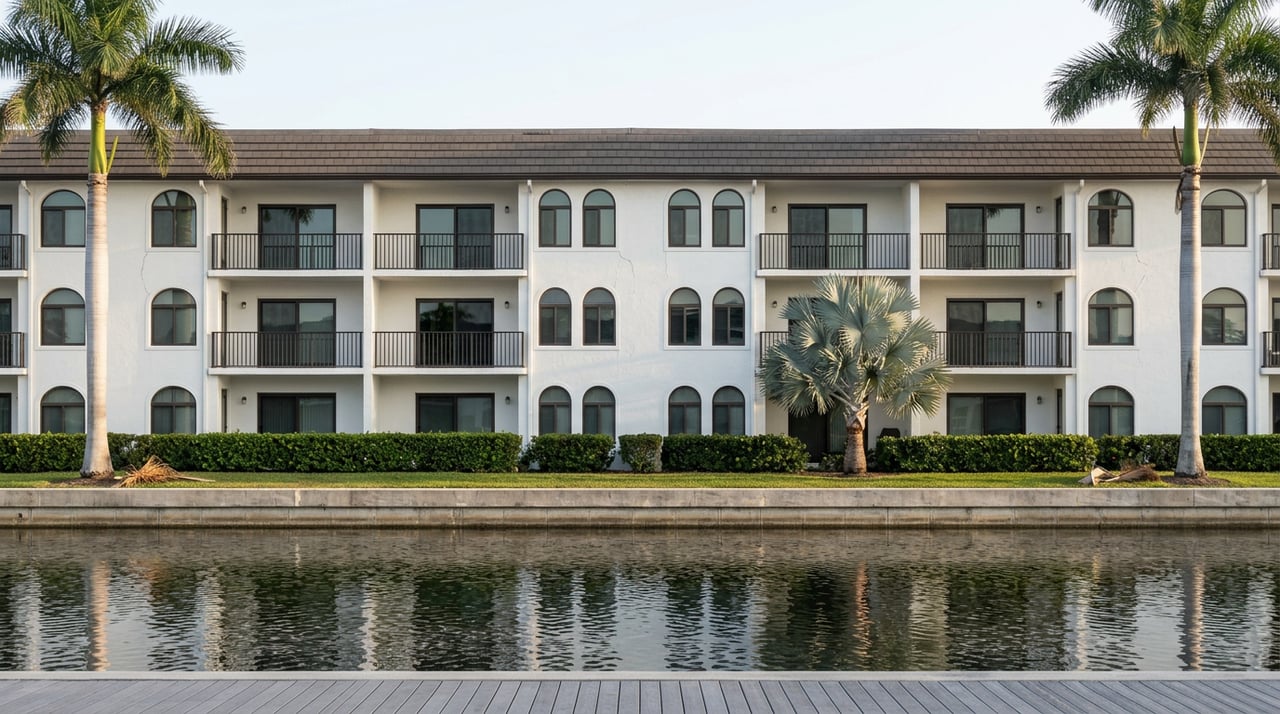
Two condo buildings sit less than a mile apart in Fort Myers. Same decade of construction. Same three stories. Same certificate of occupancy year, near enough that an appraiser would call them comparable without a second thought. One of them has to complete its structural inspection five years earlier than the other, purely because it sits closer to the water.
That is not a hypothetical quirk buried in a statute nobody reads. It is how Florida's post-Surfside building safety law actually works, and it is one of the least understood facts shaping condo dues, financing, and resale value across Lee County right now. If you are buying, selling, or already own a condo in a building three stories or taller in Fort Myers, the calendar that matters is not the one tied to your building's birthday. It is the one tied to its distance from salt water.
Why the clock starts at the waterline, not the birthday
Florida Statute 553.899 requires condominium and cooperative buildings three or more habitable stories tall to undergo a Milestone Inspection once they reach 30 years of age, based on the date the certificate of occupancy was issued, and every ten years after that. The law was written in direct response to the collapse of Champlain Towers South in Surfside on June 24, 2021, which killed 98 people. Lawmakers passed Senate Bill 4-D less than a year later, in May 2022, to keep that kind of deferred structural risk from staying invisible for decades.
The detail that trips up buyers is the coastal exception. The original law set a 25-year trigger, five years earlier than the standard, for any building within three miles of a coastline. A later amendment made that earlier trigger optional rather than automatic, handing the decision to local building departments. Lee County and Collier County, home to Fort Myers and Naples, are among the coastal jurisdictions that have generally kept that earlier requirement in practice for buildings within the three-mile band. That is why two buildings of the same age, a few blocks apart, can land on different inspection schedules depending on which side of that invisible line they sit on.
Here is how the transition deadlines break down for buildings that already existed when the law passed:
| Building's 30th birthday (by certificate of occupancy) | Milestone Inspection deadline |
|---|---|
| Reached 30 years old before July 1, 2022 | December 31, 2024 |
| Turns 30 between July 1, 2022 and December 31, 2024 | December 31, 2025 |
| Within three miles of the coast | 25-year trigger may apply instead of 30 |
| Every building afterward | Every 10 years from the initial inspection |
If you are shopping for a condo in Edison Park, downtown Fort Myers, or along the river closer to the water, the honest question to ask is not "how old is this building." It is "how far is this building from the coastline as the county defines it, and when did that clock start."
The dues on the listing are not the number in the reserve study
Every condo listing shows a monthly HOA fee. What it does not show is whether that fee reflects what the building's Structural Integrity Reserve Study, known as a SIRS, says the association actually needs to set aside.
For decades, Florida condo boards could vote to waive or underfund reserves to keep dues low. That flexibility is largely gone now. Under changes that took effect for budgets adopted on or after January 1, 2025, associations can no longer waive reserve funding for the eight structural components a SIRS is required to cover:
- Roof
- Load-bearing walls and primary structural systems
- Fire protection systems
- Plumbing
- Electrical systems
- Waterproofing and exterior painting
- Windows and exterior doors
- Any other item whose deferred maintenance or replacement cost exceeds the statutory threshold, which the state adjusts annually for inflation
Full funding for those categories was required to begin by January 1, 2026. That means a Fort Myers condo with a HOA fee that looks modest today may be sitting on a SIRS report that calls for a much higher contribution than the current budget reflects, especially if the association spent years voting to waive reserves before the rules changed. A buyer comparing two similarly priced units with similar-looking dues is not actually comparing similar risk. One building may already be funded to its SIRS schedule. The other may be one budget cycle away from a steep increase or a special assessment to close the gap.
The safest read of a dues number is not what it costs today. It is where that number sits relative to what the building's own engineer says it should be.
What changed on January 1, 2026, and why it matters before you write an offer
Two additional pieces of the law took effect at the start of this year that directly affect due diligence.
First, board members must now sign an affidavit acknowledging they received the SIRS, and that affidavit becomes part of the association's official records. It is a small requirement on paper, but it means there is now a specific, dated document a buyer or their agent can ask to see as proof the report exists and the board has formally acknowledged it.
Second, transparency rules tied to House Bill 1021 lowered the threshold for associations required to post governing documents, budgets, and reserve studies online, from buildings of 150 units down to buildings of 25 units or more, effective January 1, 2026. That gives buyers a much more direct path to the actual SIRS and Milestone Inspection reports before closing, rather than relying on a seller's or listing agent's summary of them.
Before writing an offer on a Fort Myers condo three stories or taller, it is worth requesting:
- The completed Milestone Inspection report, including Phase 2 findings if a Phase 1 inspection flagged structural deterioration
- The current SIRS and its funding schedule
- The board affidavit acknowledging receipt of the SIRS
- The last 12 months of board meeting minutes, which often surface early discussion of an upcoming special assessment before it becomes a formal notice
- Confirmation of the building's distance from the coastline and which inspection age trigger applies to it
- The building's status with any conventional lender's condo project eligibility list, since buildings without a completed Milestone Inspection can lose access to standard financing
None of this is a reason to avoid Fort Myers condos. It is a reason to ask for the right two documents before the rest of the process moves forward. Attorneys who work in this area, including Fort Myers-based counsel who write regularly on these statutory changes for the News-Press, have noted that the shift in the law is less about creating new paperwork and more about closing a decades-old gap between what boards told owners their buildings needed and what they actually funded.
Elsewhere in Florida, the cost of that gap has been severe. Buildings in Miami-Dade have seen assessments reach into six figures per unit once deferred structural work finally came due. Those are not Fort Myers examples, and nothing in the research for this piece points to comparable numbers locally, but they illustrate exactly why the law changed and why the documents above are worth the extra week it takes to gather them.
A few questions worth settling before you go further
What is the actual difference between a Milestone Inspection and a SIRS? A Milestone Inspection answers whether the building is structurally safe to keep occupying right now. A SIRS answers whether the association has enough money set aside to repair or replace major structural components over the long term. Buildings often need both, and the law allows them to be coordinated with a single engineer to save time and cost.
Does any of this apply to my two-story condo or a duplex? No. Both the Milestone Inspection and SIRS requirements apply specifically to buildings three or more habitable stories tall. Single-family homes, duplexes, triplexes, and buildings with three or fewer habitable stories above ground are exempt.
My building already completed its Milestone Inspection years ago. Am I finished? Not permanently. Inspections repeat every ten years from the initial one, and a SIRS must be updated at least every ten years as well. A completed report from several years ago is a good sign, but it is worth confirming the date and asking whether the reserve funding schedule tied to it has kept pace with the current budget.
Buying or selling a Fort Myers condo means reading a building's paperwork as carefully as its floor plan. If you want help pulling the right documents before you write an offer, or making sense of what a SIRS report actually means for your unit, Bernie Stiller and the Top Selling Realty team can walk through it with you in plain terms and in the language you're most comfortable in.